I checked on the flatworms a few days ago and found that:
1) I had a few less flatworms than I did before (specifically, the Dendrocoelum lacteum were missing)
2) I had 5 small brown balls attached to the upper sides of the tank, near but below the water line.
My first thought is that the Dendrocoelum had encysted somehow, as perhaps my tank was not to their liking, but after delving into the subject, I'm afraid it looks like Dendrocoelum has become the perfect meal for my Dugesia, supporting a round of egg-laying by that species. The eggs themselves are inside the cocoons, but i expect in a few weeks I'll have numerous baby Dugesia circling my tank.
Thursday, 26 August 2010

Saturday, 21 August 2010
It came from the compost heap!
One of the more familiar sights of summer is the hoverfly, that yellow bee-like insect that darts from flower to flower, or hovers in mid-air, surveying its surroundings.

But how many people have ever seen their larva?
Below is a rat-tailed maggot... larva of one of the larger groups of hoverflies, the Eristalinae. This fellow had established himself in our compost bin and was quite happy to turn our waste veggies into hoverfly material until I tipped him onto the compost heap out back.
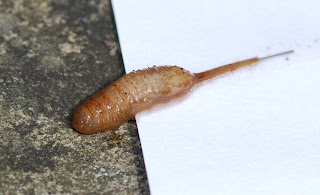
That long bit sticking out the back (the 'rat tail') is a breathing tube allowing the maggot to live in waterlogged sewage, in temporary ponds, or in any environment with lots of water and lots of organic material. I'm guessing this is a sign I need to empty the compost more frequently, though on the flip side, I can think of no better fly to be chowing down on our leftovers.
Incidentally, the fly pictured at top, Episyrphus balteatus, doesn't produce rat-tailed maggots... its larva are one of the few active, predatory fly larva and look something like small green slugs. They feed on aphids and can be found, with some careful searching, on garden plants that have been aphid infested.

But how many people have ever seen their larva?
Below is a rat-tailed maggot... larva of one of the larger groups of hoverflies, the Eristalinae. This fellow had established himself in our compost bin and was quite happy to turn our waste veggies into hoverfly material until I tipped him onto the compost heap out back.

That long bit sticking out the back (the 'rat tail') is a breathing tube allowing the maggot to live in waterlogged sewage, in temporary ponds, or in any environment with lots of water and lots of organic material. I'm guessing this is a sign I need to empty the compost more frequently, though on the flip side, I can think of no better fly to be chowing down on our leftovers.
Incidentally, the fly pictured at top, Episyrphus balteatus, doesn't produce rat-tailed maggots... its larva are one of the few active, predatory fly larva and look something like small green slugs. They feed on aphids and can be found, with some careful searching, on garden plants that have been aphid infested.
Friday, 13 August 2010
Flatworm pictures
Some pictures of the flatworms. The animals were transferred to a small plastic container and photos were taken with a macro lens. It was a bit harder than I thought it would be to get decent pics, but these are probably the best I could hope for with the equipment I have.
Incidentally, its not really clear what I should feed them. In some of the old literature with Dugesia tigrina, the authors use small cubes of liver. In the 60's, that probably wasn't hard to find, but few supermarkets stock liver these days. Liverwurst is not a substitute, apparently, but I will try some chicken meat soon. I've also tried dried bloodworms, which some of them have gone for, but its not entirely clear if they are feeding or just clinging on to them. The problem is that these are predators (Dendrocoelum in particular) and only occasionally scavengers, so I imagine simply wiggling a dead bloodworm in front of them isn't going to provoke much of a response.
Dugesia lugubris
Dendrocoelum lacteum
(Note the eyes - Dugesia has large eyes that look 'cross-eyed' - the white bit is many retinal cells, the dark patch a few pigment cells. Dendrocoelum has just two dark dots composed of two retinal cells and a pigment cell.)
Incidentally, its not really clear what I should feed them. In some of the old literature with Dugesia tigrina, the authors use small cubes of liver. In the 60's, that probably wasn't hard to find, but few supermarkets stock liver these days. Liverwurst is not a substitute, apparently, but I will try some chicken meat soon. I've also tried dried bloodworms, which some of them have gone for, but its not entirely clear if they are feeding or just clinging on to them. The problem is that these are predators (Dendrocoelum in particular) and only occasionally scavengers, so I imagine simply wiggling a dead bloodworm in front of them isn't going to provoke much of a response.

Dugesia lugubris

Dendrocoelum lacteum
(Note the eyes - Dugesia has large eyes that look 'cross-eyed' - the white bit is many retinal cells, the dark patch a few pigment cells. Dendrocoelum has just two dark dots composed of two retinal cells and a pigment cell.)
Thursday, 12 August 2010
Flatworms III

Some pictures of my flatworms: Dendrocoelum lacteum (left) and Dugesia lugubris (right). If the picture looks a bit odd, its because it was taken through the plastic of the tank with a macro lens, and what your seeing is the undersides. The lighter patch in the middle of each worm is the pharynx, which is popped out when the animal wants to suck up some food. Flatworms don't have a through digestive system, so its also where the waste leaves when digesting is done.
Despite their similarity, these species are not close relatives. Dendrocoelum is in the family Dendrocoelidae, a group of active hunters with very simple eyes and an 'adhesive organ' (sucker) at the front for holding their prey, while Dugesia is in the family Dugesiidae, a more opportunistic predator that lacks a sucker but has a much more complex eye. These species used to be all lumped together in a larger group, the Paludicola, defined as all triclad planarians (triclads are flatworms whose intestine divides into three parts) that live in fresh water. They were believed to have descended from terrestrial flatworms, who were themselves descendents of marine flatworms.
About 10 years ago, a series of molecular studies completely rewrote the book on flatworm taxonomy and gave us a very different view of their evolution. The freshwater triclad flatworms are now believed to have evolved from marine flatworms (which when you think about it, makes more sense than if they had come from terrestrial species), and at some point around 100 million years ago, the ancestor of the Dugesiids and all terrestrial flatworms split off from the ancestor of Dendrocoelum. In the process they gained a rather unique mutation - a second version of their ribosomal RNA genes. All animals have multiple copies of their ribosomal RNA genes, but because all these copies are next to each other on the DNA strand, the mechanisms of DNA copying ensure that they are all identical copies. At some point, the ancestor to the Dugesiids and land flatworms underwent a mutation that moved some copies of their ribosomal RNA genes to a different location in their chromosomes, where they could evolve in a different direction. Its not really clear what these second ribosomal RNA genes do, but they are expressed and they can be found in all of the descendents, so they must be doing something important, but different from the original ribosomal RNA. My guess is that they may only be expressed in certain tissues or at certain times of development, but I don’t think anyone has really looked into it.
Flatworms II
Part of my fascination with these humble flatworms comes from their ability to regenerate - as a youth, I remember coming across drawings of two-headed flatworms, multiheaded flatworms, and full-sized flatworms with a 'miniature' flatworm emerging from their sides. Not all flatworms display this amazing ability to regenerate, of course - depending on which version of flatworm taxonomy you accept, regeneration is thought to be an ancestral characteristic that has been reduced or lost multiple times in the evolution of this group. Some flatworms can't regenerate at all, others can regenerate most of their body, as long as the brain is intact, but for most flatworms regeneration of amputated parts tends to be limited to an area from their brain to their mouth (located around the middle of their body). They do a bit better at regenerating cuts, which leads to two-headed flatworms if you make a cut along their midline.
The flatworms that do regenerate have a cells scattered through their body called neoblasts that are thought to be totipotent - the flatworm equivalent of stem cells. When a flatworm is damaged, these cells migrate to the wound site and begin dividing and differentiating to make new tissues. What is interesting about this process is why not all flatworms regenerate, and why some are not as good at it as others even though they have neoblast cells... if you think about it, these cells are a two-edged sword. On the one hand, they allow the animal to quickly repair damage and replace lost body parts (and considering how soft and delicate these animal are, I'm sure damage is quite common), on the other hand, these cells have to be kept under tight regulation or they run the risk of replicating out of control - essentially becoming cancer cells. Even a regeneration that is 'mostly' correct can be fatal - two headed flatworms appear to die after a month or so. I suspect that for some lineages of flatworms, the risks of uncontrolled regeneration or cancer have outweighed the benefits of fast healing and replacing amputated parts, and over time the ability to regenerate has either been lost outright or various mechanisms to regulate and restrict these cells have evolved.
Of course there are other factors that may help maintain the ability to regenerate. A number of flatworm species can reproduce by splitting in two, and while there are differences between fission and regeneration, neoblast cells are involved in both processes. Interestingly, in some of these asexual species, if they do become sexual and develop ovaries, they lose much of their ability to regenerate. There are also similarities between early growth and regeneration, suggesting that regeneration could be a retention in the adults of growth mechanisms in the juvenile. It would be interesting to look at some of the poor- and non-regenerating species and see if their juveniles show greater regenerative powers than the adults.
As for my own flatworms, I'm a bit undecided as to whether I will be cutting them up to create two-headed monsters of the water-tank... for one, cutting a tiny flatworm is probably a lot harder than it sounds if all you have is an old microscope, a hand-lamp, and a kitchen knife (ah for the days when I had access to a full laboratory!). For another, where people have bothered to study the fate of these multi-headed worms, their lifespans have been much shorter than normal, and for now I just want to see if I can keep them alive in a small tank. These aren't the 'classic' lab flatworms with the arrow-shaped heads (Dugesia tigrina), so I don't have as much to go on about culturing these species.
The flatworms that do regenerate have a cells scattered through their body called neoblasts that are thought to be totipotent - the flatworm equivalent of stem cells. When a flatworm is damaged, these cells migrate to the wound site and begin dividing and differentiating to make new tissues. What is interesting about this process is why not all flatworms regenerate, and why some are not as good at it as others even though they have neoblast cells... if you think about it, these cells are a two-edged sword. On the one hand, they allow the animal to quickly repair damage and replace lost body parts (and considering how soft and delicate these animal are, I'm sure damage is quite common), on the other hand, these cells have to be kept under tight regulation or they run the risk of replicating out of control - essentially becoming cancer cells. Even a regeneration that is 'mostly' correct can be fatal - two headed flatworms appear to die after a month or so. I suspect that for some lineages of flatworms, the risks of uncontrolled regeneration or cancer have outweighed the benefits of fast healing and replacing amputated parts, and over time the ability to regenerate has either been lost outright or various mechanisms to regulate and restrict these cells have evolved.
Of course there are other factors that may help maintain the ability to regenerate. A number of flatworm species can reproduce by splitting in two, and while there are differences between fission and regeneration, neoblast cells are involved in both processes. Interestingly, in some of these asexual species, if they do become sexual and develop ovaries, they lose much of their ability to regenerate. There are also similarities between early growth and regeneration, suggesting that regeneration could be a retention in the adults of growth mechanisms in the juvenile. It would be interesting to look at some of the poor- and non-regenerating species and see if their juveniles show greater regenerative powers than the adults.
As for my own flatworms, I'm a bit undecided as to whether I will be cutting them up to create two-headed monsters of the water-tank... for one, cutting a tiny flatworm is probably a lot harder than it sounds if all you have is an old microscope, a hand-lamp, and a kitchen knife (ah for the days when I had access to a full laboratory!). For another, where people have bothered to study the fate of these multi-headed worms, their lifespans have been much shorter than normal, and for now I just want to see if I can keep them alive in a small tank. These aren't the 'classic' lab flatworms with the arrow-shaped heads (Dugesia tigrina), so I don't have as much to go on about culturing these species.
Tuesday, 10 August 2010
Flatworms
Been catching flatworms in the river near where I live... I was able to catch several black ones, two grey ones, and a white one. The black ones are almost certainly Dugesia polychroa... the white one possibly Phagocota vitta. I'll have to wait a bit until they settle down before I can take a closer look at the white and grey ones. Flatworms have always fascinated me, ever since reading about them in an old copy of 'Animals without backbones'. The problem of course was finding them... the streams near where I lived (as a child) were muddy and not really suitable for them. My identifications are from Ball and Reynoldson's "British Planarians", which may be a bit dated. Hopefully I'll figure out a way to get some pictures of them posted.
Sunday, 1 August 2010
Beautiful blue
This blue jellyfish was kind enough to do a somersault, giving me a good view of both its top and underside.
My god, its full of stars!
Asterias rubens to be exact. These starfish were numerous at the dive site, mostly on rocks but some were on the shell-gravel. If you look carefully at both photos, you can see a second smaller starfish nearby in each of them.

This individual below is eating a clam - the clam isn't obvious, but the body of the starfish is positioned over it, and the stomach has been inserted into the clam shell.


This individual below is eating a clam - the clam isn't obvious, but the body of the starfish is positioned over it, and the stomach has been inserted into the clam shell.

Diving at St.Abbs
Common sea urchins in abundance at St. Abbs, Scotland.
Below, you can see the tube feet wafting in the current.
Below, you can see the tube feet wafting in the current.
Saturday, 24 July 2010
Butterfly week
Its butterfly week, apparently.... not that your likely to see many in this part of England. Years of wet weather has given the native species a big hit lately, but the ultimate cause is changing land use patterns that have reduced the available habitat and eliminated many of the host plants our native butterflies use. The problem, of course, is its a gradual process that has been going on for the last 30 years, so many people today don't really realize what they are missing. Coming from North America, its painfully obvious how few insects remain in England, but even just picking up an old UK field guide or nature book published in the 50's or 60's and flipping through the pages reveals insect after insect that is either locally extinct or rarely seen.
Anyway, some photos of a species that is still common here: a larval Vapourer moth (Orgyia antiqua) munching on my roses.


Anyway, some photos of a species that is still common here: a larval Vapourer moth (Orgyia antiqua) munching on my roses.


Friday, 23 July 2010
Coraline Cruelty
I've been reading an interesting paper in bioessays which redescribes the symbiotic relationship between corals and their algae from one of mutalism to one of... well.... vampirism? Slavery? Rather than happy zooxanthellae producing sugars for their grateful host while basking in the protection of the coral polyps cnidocytes, the little algae are tricked into getting close to the coral, mercilessly engulfed by the gut cells, and then have to undergo a cruel process of selection, where over a period of days to years, they are tested, and most digested, with an unlucky few forced to live a life of indentured servitude, producing carbon for their coraline masters!
I'll never look at a coral the same way again.
I'll never look at a coral the same way again.
Wednesday, 30 June 2010
Its been a while
Real life insists on intruding... though given the great weather at the moment, I can't help thinking there are better things to do than spend my life on a computer.
I've been thinking recently about the lack of insects in this country (a topic I've touched on before) and will post a bit on this over the next few days. For now, a picture of a bumblebee... one of the few species in this group that seem to be doing well.

I've been thinking recently about the lack of insects in this country (a topic I've touched on before) and will post a bit on this over the next few days. For now, a picture of a bumblebee... one of the few species in this group that seem to be doing well.

Sunday, 23 May 2010
Day flying moths
Real life has been bogging things down for me this week, but after a beautiful day in Harrogate, I have some great shots of day flying moths - one fairly famous one, and one less seen but equally interesting.


The Cinnabar moth (Tyria jacobaeae) is most famous as the orange and black striped caterpillars often found on ragwort that supposedly inspired W.D. Hamilton to lay down the theory of kin selection (or at least, thats the popular anecdote). The caterpillars are both highly visible, very social and toxic, and birds that try to feed on one soon learn to leave them alone - thus the caterpillar that is eaten spares his brothers and sisters on the same plant a similar fate. Of course, warning coloration is a bit more widespread and rarely do birds try and eat the caterpillars - as well as there being a degree of kin selection, the caterpillars are taking advantage of the fact that many other distasteful insects share the same coloration.

Smaller and less noticed is the Fairy Longhorn moth (probably Adela reaumurella), a member of one of the more primitive branches of the lepidopteran family tree. I observed dozens of them flying around the sunlit leaves of a single tree in a patch of forest near Harrogate - fortunately they were not too bothered by my presence and I could take this photograph.


The Cinnabar moth (Tyria jacobaeae) is most famous as the orange and black striped caterpillars often found on ragwort that supposedly inspired W.D. Hamilton to lay down the theory of kin selection (or at least, thats the popular anecdote). The caterpillars are both highly visible, very social and toxic, and birds that try to feed on one soon learn to leave them alone - thus the caterpillar that is eaten spares his brothers and sisters on the same plant a similar fate. Of course, warning coloration is a bit more widespread and rarely do birds try and eat the caterpillars - as well as there being a degree of kin selection, the caterpillars are taking advantage of the fact that many other distasteful insects share the same coloration.

Smaller and less noticed is the Fairy Longhorn moth (probably Adela reaumurella), a member of one of the more primitive branches of the lepidopteran family tree. I observed dozens of them flying around the sunlit leaves of a single tree in a patch of forest near Harrogate - fortunately they were not too bothered by my presence and I could take this photograph.
Sunday, 16 May 2010
Sleepy sunday

I took this photo in south Australia, in an area of parkland containing thinly distributed eucalyptus trees interspersed among low bushes and grassland, not far from the remnant Myrtle Beech forest where I photographed the cicada molt skin. There were several koalas in the area (easy to spot - just look for clusters of tourists with their cameras out), almost all fast asleep save for one who was casually munching away at the eucalyptus leaves. The popular image of koalas is that they live an idyllic life of ease, probably due to the long periods they spend sleeping (up to 20 hours a day). In truth, eucalyptus is such a poor food resource that they need these long periods of rest to digest it - I guess the advantage is that they don't have much competition.
A hundred thousand years ago, there would have been no koalas where I took this photo - the forest would have been a dense thicket of Myrtle Beech, tree ferns, cycads, and other jungle plants, with few if any eucalyptus for a koala to feed on. Koalas came to this section of parkland in south Australia with the eucalyptus forest, and the forest came with the aboriginals. The practice of burning to clear the land pushed back the Myrtle forests, while the eucalyptus thrived in the fire zone. Eucalyptus is highly adapted to fire, being able to both survive and spread after fire sweeps through the forests, while taking advantage of the fire to eliminate competing plant species... and I suppose hungry koalas.
Saturday, 15 May 2010
In the garden
I've been reading the book Garden Natural History which has inspired the latest round of backyard photography. Its fascinating how much goes on in the garden that most people aren't aware of - all the more so given my habit for letting it run a bit wild. Most of the activity is below the surface - mites, burrowing insects, worms, and other scavengers of the soil (and the creatures who prey on them) but there is a host of activity going on above the surface - aphids, parasitoid wasps, flies and butterflies, and of course the host of mosses, lichens, fungi and other less-visible plants that along with the grass and garden plants are the basis of this ecosystem. Its unfortunate that I'm probably one of the few people who appreciate all the activity going on in the back-yard... most people in England seem to want that perfect lawn (in other words a grass monoculture trimmed to resemble a sheep-grazed field, without the benefit of sheep dung or the various plants that thrive in sheep fields) while others have taken to removing the grass entirely and replacing it with stones or tiles. Its almost as though the urban biodiversity of this nation is at the mercy of home-owners with an obsessive-compulsive view about tidiness and order.

Friday, 14 May 2010
Silent Night II
By coincidence I came across an advertisement for this new book out Silent Summer which goes into detail what I've been noticing in the past few years - how the various insect and other invertebrate species are dying out in this country. Sixteen years ago I visited the UK as a budding young entomologist and returned home with several specimens of what were at the time unprotected species, but which are now on the endangered list, if not actually extinct in this country. Sixteen years is not a long time... barely a generation... yet in this time 5 species of butterfly have gone extinct here, and the majority of the remaining species are endangered.
I'll need to get myself a copy of that book... I don't think it will make happy reading.
I'll need to get myself a copy of that book... I don't think it will make happy reading.
Thursday, 13 May 2010
Silent Night

I miss cicadas.
I don't think most people in this country realize how noisy the countryside should be, or would think something is wrong when walking through a silent field at night. There is only one species of cicada in England and its restricted to the New Forest in the south. There are several species of crickets and grasshoppers as well, but I have only rarely seen them (again in the south) and never heard one calling. To someone who grew up in the colonies, its horribly unnatural to hear so little of the night chorus and highlights the degree to which this country has extirpated its local fauna. One of the saddest aspects is that thanks to Victorian and Edwardian collectors and enthusiasts, there is no country with a better record of the species of insects and other invertebrates that live here, and yet this record makes it painfully clear just how much the native species have been extinguished from this island with so many species either locally extinct, pushed into patches of marginal territory, or in the case of the once common freshwater pearl mussel (Margaritifera margaritifera) and several of the oak species, only ancient individuals remain with no young having been recruited for decades. Changing climates (and a run of bad summers) is expected to put several of the rarer butterfly species here at risk of extinction from these islands, but as these species have become so restricted in their locations, I'm not sure anyone but a handful of experts will notice that they are gone.
...and that of course is the problem. Its been a slow and gradual process of loss, such that the scale has not been apparent to the average resident. Most Englanders my age think that what they run across (or more, what they don't run across) when out in the countryside is "normal". Their parents may remember there being more butterflies or more of some flowers (perhaps they once saw a lady slipper orchid in the woods - now these flowers are so rare they need police protection) but its been such a gradual process that even they have largely accepted it. Its only once you look back at the old records - descriptions of clouds of moths surrounding gas lamps, or boxes containing hundreds of faded moth specimens - that you appreciate the scale of the loss.
The picture, by the way, is a cicada molt skin photographed in a small Myrtle Beech forest in south Australia. I've still never had the luck to find one here in England.
Tuesday, 11 May 2010
Pufferfish
Among the butterfly fish, wrasse, parrotfish, and other colorful denizens of the reef, its easy to overlook some of the less spectacular but no less interesting inhabitants. This fellow is a blackspotted pufferfish (Arothron nigropunctatus) that meandered into view while snorkeling on the reef near Cairns. He doesn't seem particularly bothered by my presence... not surprising as he has few if any predators to worry about, save the occasional japanese chef.
Its not one of the species that can be served as fugu, but its no less dangerous, and being packed full of tetradoxins no doubt gives it a sense of confidence that other, similarly sized fish might lack.
Wednesday, 5 May 2010
Why I won't vote labour
After reading the reviews of the candidates at whoshouldshipleyvotefor and attending a hustings myself, I have to say that I was more impressed than I thought I would be with the Labour candidate Susan Hinchcliffe. Part of me thinks that she could be a decent MP for Shipley, and probably is more representative of my opinion than her most serious rival Philip Davies.
However... (and its a big however), I don't think in the end it matters much what she does or doesn't believe. The Labour party that I am familiar with is an autocratic organization in which the unelected but monied few have far more say than the elected MPs, and where during the Labour administration a rot has been allowed to set in throughout all levels of government that has led to both MPs and senior civil servants being more interested in personal advancement than in serving the country. I've seen it personally, internally during a brief stint in government, and externally in the steady parade of external consultants and PFI businessmen (and women) who have infiltrated every aspect of government, taking huge amounts of taxpayer money and delivering nothing but promises.
And of course, theres the war. I'm not sure if it would have made much of a difference to Bush if Blair had not gone along, but it certainly would have helped if Blair and the Labour party had not turned into lapdogs for an aggressive and misguided administration. Theres is blood on their hands, and it is smeared over all of those who continue in Labours name.
Some things cannot be forgiven.
However... (and its a big however), I don't think in the end it matters much what she does or doesn't believe. The Labour party that I am familiar with is an autocratic organization in which the unelected but monied few have far more say than the elected MPs, and where during the Labour administration a rot has been allowed to set in throughout all levels of government that has led to both MPs and senior civil servants being more interested in personal advancement than in serving the country. I've seen it personally, internally during a brief stint in government, and externally in the steady parade of external consultants and PFI businessmen (and women) who have infiltrated every aspect of government, taking huge amounts of taxpayer money and delivering nothing but promises.
And of course, theres the war. I'm not sure if it would have made much of a difference to Bush if Blair had not gone along, but it certainly would have helped if Blair and the Labour party had not turned into lapdogs for an aggressive and misguided administration. Theres is blood on their hands, and it is smeared over all of those who continue in Labours name.
Some things cannot be forgiven.
Subscribe to:
Posts (Atom)