Its butterfly week, apparently.... not that your likely to see many in this part of England. Years of wet weather has given the native species a big hit lately, but the ultimate cause is changing land use patterns that have reduced the available habitat and eliminated many of the host plants our native butterflies use. The problem, of course, is its a gradual process that has been going on for the last 30 years, so many people today don't really realize what they are missing. Coming from North America, its painfully obvious how few insects remain in England, but even just picking up an old UK field guide or nature book published in the 50's or 60's and flipping through the pages reveals insect after insect that is either locally extinct or rarely seen.
Anyway, some photos of a species that is still common here: a larval Vapourer moth (Orgyia antiqua) munching on my roses.
Saturday, 24 July 2010
Friday, 23 July 2010
Coraline Cruelty
I've been reading an interesting paper in bioessays which redescribes the symbiotic relationship between corals and their algae from one of mutalism to one of... well.... vampirism? Slavery? Rather than happy zooxanthellae producing sugars for their grateful host while basking in the protection of the coral polyps cnidocytes, the little algae are tricked into getting close to the coral, mercilessly engulfed by the gut cells, and then have to undergo a cruel process of selection, where over a period of days to years, they are tested, and most digested, with an unlucky few forced to live a life of indentured servitude, producing carbon for their coraline masters!
I'll never look at a coral the same way again.
Wednesday, 30 June 2010
Its been a while
Real life insists on intruding... though given the great weather at the moment, I can't help thinking there are better things to do than spend my life on a computer.
I've been thinking recently about the lack of insects in this country (a topic I've touched on before) and will post a bit on this over the next few days. For now, a picture of a bumblebee... one of the few species in this group that seem to be doing well.
Sunday, 23 May 2010
Day flying moths
Real life has been bogging things down for me this week, but after a beautiful day in Harrogate, I have some great shots of day flying moths - one fairly famous one, and one less seen but equally interesting.
The Cinnabar moth (Tyria jacobaeae) is most famous as the orange and black striped caterpillars often found on ragwort that supposedly inspired W.D. Hamilton to lay down the theory of kin selection (or at least, thats the popular anecdote). The caterpillars are both highly visible, very social and toxic, and birds that try to feed on one soon learn to leave them alone - thus the caterpillar that is eaten spares his brothers and sisters on the same plant a similar fate. Of course, warning coloration is a bit more widespread and rarely do birds try and eat the caterpillars - as well as there being a degree of kin selection, the caterpillars are taking advantage of the fact that many other distasteful insects share the same coloration.
Smaller and less noticed is the Fairy Longhorn moth (probably Adela reaumurella), a member of one of the more primitive branches of the lepidopteran family tree. I observed dozens of them flying around the sunlit leaves of a single tree in a patch of forest near Harrogate - fortunately they were not too bothered by my presence and I could take this photograph.
The Cinnabar moth (Tyria jacobaeae) is most famous as the orange and black striped caterpillars often found on ragwort that supposedly inspired W.D. Hamilton to lay down the theory of kin selection (or at least, thats the popular anecdote). The caterpillars are both highly visible, very social and toxic, and birds that try to feed on one soon learn to leave them alone - thus the caterpillar that is eaten spares his brothers and sisters on the same plant a similar fate. Of course, warning coloration is a bit more widespread and rarely do birds try and eat the caterpillars - as well as there being a degree of kin selection, the caterpillars are taking advantage of the fact that many other distasteful insects share the same coloration.
Smaller and less noticed is the Fairy Longhorn moth (probably Adela reaumurella), a member of one of the more primitive branches of the lepidopteran family tree. I observed dozens of them flying around the sunlit leaves of a single tree in a patch of forest near Harrogate - fortunately they were not too bothered by my presence and I could take this photograph.
Sunday, 16 May 2010
Sleepy sunday
I took this photo in south Australia, in an area of parkland containing thinly distributed eucalyptus trees interspersed among low bushes and grassland, not far from the remnant Myrtle Beech forest where I photographed the cicada molt skin. There were several koalas in the area (easy to spot - just look for clusters of tourists with their cameras out), almost all fast asleep save for one who was casually munching away at the eucalyptus leaves. The popular image of koalas is that they live an idyllic life of ease, probably due to the long periods they spend sleeping (up to 20 hours a day). In truth, eucalyptus is such a poor food resource that they need these long periods of rest to digest it - I guess the advantage is that they don't have much competition.
A hundred thousand years ago, there would have been no koalas where I took this photo - the forest would have been a dense thicket of Myrtle Beech, tree ferns, cycads, and other jungle plants, with few if any eucalyptus for a koala to feed on. Koalas came to this section of parkland in south Australia with the eucalyptus forest, and the forest came with the aboriginals. The practice of burning to clear the land pushed back the Myrtle forests, while the eucalyptus thrived in the fire zone. Eucalyptus is highly adapted to fire, being able to both survive and spread after fire sweeps through the forests, while taking advantage of the fire to eliminate competing plant species... and I suppose hungry koalas.
Saturday, 15 May 2010
In the garden
I've been reading the book Garden Natural History which has inspired the latest round of backyard photography. Its fascinating how much goes on in the garden that most people aren't aware of - all the more so given my habit for letting it run a bit wild. Most of the activity is below the surface - mites, burrowing insects, worms, and other scavengers of the soil (and the creatures who prey on them) but there is a host of activity going on above the surface - aphids, parasitoid wasps, flies and butterflies, and of course the host of mosses, lichens, fungi and other less-visible plants that along with the grass and garden plants are the basis of this ecosystem. Its unfortunate that I'm probably one of the few people who appreciate all the activity going on in the back-yard... most people in England seem to want that perfect lawn (in other words a grass monoculture trimmed to resemble a sheep-grazed field, without the benefit of sheep dung or the various plants that thrive in sheep fields) while others have taken to removing the grass entirely and replacing it with stones or tiles. Its almost as though the urban biodiversity of this nation is at the mercy of home-owners with an obsessive-compulsive view about tidiness and order.
Friday, 14 May 2010
Silent Night II
By coincidence I came across an advertisement for this new book out Silent Summer which goes into detail what I've been noticing in the past few years - how the various insect and other invertebrate species are dying out in this country. Sixteen years ago I visited the UK as a budding young entomologist and returned home with several specimens of what were at the time unprotected species, but which are now on the endangered list, if not actually extinct in this country. Sixteen years is not a long time... barely a generation... yet in this time 5 species of butterfly have gone extinct here, and the majority of the remaining species are endangered.
I'll need to get myself a copy of that book... I don't think it will make happy reading.
Thursday, 13 May 2010
Silent Night

I miss cicadas.
I don't think most people in this country realize how noisy the countryside should be, or would think something is wrong when walking through a silent field at night. There is only one species of cicada in England and its restricted to the New Forest in the south. There are several species of crickets and grasshoppers as well, but I have only rarely seen them (again in the south) and never heard one calling. To someone who grew up in the colonies, its horribly unnatural to hear so little of the night chorus and highlights the degree to which this country has extirpated its local fauna. One of the saddest aspects is that thanks to Victorian and Edwardian collectors and enthusiasts, there is no country with a better record of the species of insects and other invertebrates that live here, and yet this record makes it painfully clear just how much the native species have been extinguished from this island with so many species either locally extinct, pushed into patches of marginal territory, or in the case of the once common freshwater pearl mussel (Margaritifera margaritifera) and several of the oak species, only ancient individuals remain with no young having been recruited for decades. Changing climates (and a run of bad summers) is expected to put several of the rarer butterfly species here at risk of extinction from these islands, but as these species have become so restricted in their locations, I'm not sure anyone but a handful of experts will notice that they are gone.
...and that of course is the problem. Its been a slow and gradual process of loss, such that the scale has not been apparent to the average resident. Most Englanders my age think that what they run across (or more, what they don't run across) when out in the countryside is "normal". Their parents may remember there being more butterflies or more of some flowers (perhaps they once saw a lady slipper orchid in the woods - now these flowers are so rare they need police protection) but its been such a gradual process that even they have largely accepted it. Its only once you look back at the old records - descriptions of clouds of moths surrounding gas lamps, or boxes containing hundreds of faded moth specimens - that you appreciate the scale of the loss.
The picture, by the way, is a cicada molt skin photographed in a small Myrtle Beech forest in south Australia. I've still never had the luck to find one here in England.
Tuesday, 11 May 2010
Pufferfish
Among the butterfly fish, wrasse, parrotfish, and other colorful denizens of the reef, its easy to overlook some of the less spectacular but no less interesting inhabitants. This fellow is a blackspotted pufferfish (Arothron nigropunctatus) that meandered into view while snorkeling on the reef near Cairns. He doesn't seem particularly bothered by my presence... not surprising as he has few if any predators to worry about, save the occasional japanese chef.
Its not one of the species that can be served as fugu, but its no less dangerous, and being packed full of tetradoxins no doubt gives it a sense of confidence that other, similarly sized fish might lack.
Wednesday, 5 May 2010
Why I won't vote labour
After reading the reviews of the candidates at whoshouldshipleyvotefor and attending a hustings myself, I have to say that I was more impressed than I thought I would be with the Labour candidate Susan Hinchcliffe. Part of me thinks that she could be a decent MP for Shipley, and probably is more representative of my opinion than her most serious rival Philip Davies.
However... (and its a big however), I don't think in the end it matters much what she does or doesn't believe. The Labour party that I am familiar with is an autocratic organization in which the unelected but monied few have far more say than the elected MPs, and where during the Labour administration a rot has been allowed to set in throughout all levels of government that has led to both MPs and senior civil servants being more interested in personal advancement than in serving the country. I've seen it personally, internally during a brief stint in government, and externally in the steady parade of external consultants and PFI businessmen (and women) who have infiltrated every aspect of government, taking huge amounts of taxpayer money and delivering nothing but promises.
And of course, theres the war. I'm not sure if it would have made much of a difference to Bush if Blair had not gone along, but it certainly would have helped if Blair and the Labour party had not turned into lapdogs for an aggressive and misguided administration. Theres is blood on their hands, and it is smeared over all of those who continue in Labours name.
Some things cannot be forgiven.
However... (and its a big however), I don't think in the end it matters much what she does or doesn't believe. The Labour party that I am familiar with is an autocratic organization in which the unelected but monied few have far more say than the elected MPs, and where during the Labour administration a rot has been allowed to set in throughout all levels of government that has led to both MPs and senior civil servants being more interested in personal advancement than in serving the country. I've seen it personally, internally during a brief stint in government, and externally in the steady parade of external consultants and PFI businessmen (and women) who have infiltrated every aspect of government, taking huge amounts of taxpayer money and delivering nothing but promises.
And of course, theres the war. I'm not sure if it would have made much of a difference to Bush if Blair had not gone along, but it certainly would have helped if Blair and the Labour party had not turned into lapdogs for an aggressive and misguided administration. Theres is blood on their hands, and it is smeared over all of those who continue in Labours name.
Some things cannot be forgiven.
Batfish
A fine specimen of Platax orbicularis, the orbicular batfish, observed underneath the boat off the barrier reef. These fish like to hang around near the boats during the day, to be replaced by sharks and trevallies during the night.
Tuesday, 4 May 2010
Elections
Its unfortunate, but I seem to live in one of those ridings where the electorate is either red or blue, with no room for other voices. How else to explain why the Lib Dems, who seem so energetic in other places, have such a lacklustre campaign here? Its one of the unfortunate effects of the first-past-the-post system that voters in non-marginal constituencies are essentially ignored.
I sent an email around to the various local candidates to see what their opinions were on the cut in university funding. No response from the Lib Dem candidate, and the Green party candidate wanted to confirm that I lived in the riding (and why would that make a difference? This is a national issue, not a local one!). The Labour candidate replied, but only saw this as an education issue, while the Conservative candidate saw this as an issue of poor management of resources.
Personally, I think this is an issue of short-term thinking. By not funding the research posts in higher education, a generation of scientists, engineers, mathematicians, and computer scientists will be lost forever to this country... some will go overseas, but most will simply drop out of their fields to find paying work in business. Besides being a tremendous waste of educational investment, it also means that the brains this country needs to help pull this country out of recession will have gone elsewhere or long since left the cutting edge of their fields when the recovery occurs. Its said that once a person leaves the sciences, they leave for good... I know personally that this is true, even if they want to return... and we are dooming a generation of newly-minted PhD's to essentially chuck away their expensive tax-supported education for lack of any other options.
Unfortunately, I don't think any of the parties really grasp that. There are very few scientists... in fact very few people with any post-graduate technical education in the House of Commons. Instead we have spin-doctors and party hacks, with no appreciation for the long-term future of this country
I sent an email around to the various local candidates to see what their opinions were on the cut in university funding. No response from the Lib Dem candidate, and the Green party candidate wanted to confirm that I lived in the riding (and why would that make a difference? This is a national issue, not a local one!). The Labour candidate replied, but only saw this as an education issue, while the Conservative candidate saw this as an issue of poor management of resources.
Personally, I think this is an issue of short-term thinking. By not funding the research posts in higher education, a generation of scientists, engineers, mathematicians, and computer scientists will be lost forever to this country... some will go overseas, but most will simply drop out of their fields to find paying work in business. Besides being a tremendous waste of educational investment, it also means that the brains this country needs to help pull this country out of recession will have gone elsewhere or long since left the cutting edge of their fields when the recovery occurs. Its said that once a person leaves the sciences, they leave for good... I know personally that this is true, even if they want to return... and we are dooming a generation of newly-minted PhD's to essentially chuck away their expensive tax-supported education for lack of any other options.
Unfortunately, I don't think any of the parties really grasp that. There are very few scientists... in fact very few people with any post-graduate technical education in the House of Commons. Instead we have spin-doctors and party hacks, with no appreciation for the long-term future of this country
Garsdale
There seems to be a May holiday weekend tradition that every hiker with something to prove descends on the Three Peaks region of the Dales. Not surprisingly, despite wind, hail, and a complete lack of training, long lines of gortex-clade pilgrims made their slow painful journey from Whernside to Ingleborough and from there on to Pen-y-ghent... much complaining could be heard, as muscles that lay unused over the long winter were forced up one side of the mountain and then trudged painfully down the other...
In contrast, the quiet valley of Garsdale just to the north had nary a visitor... just peaceful hiking, inquisitive ponies, and wildflowers waking to a late spring.
Primulus vulgaris, the common primrose could be seen in abundance in the low-lying portion of the valley, while Butterbur (Petasites hybridus) below was still in bloom in the marshy regions near the road. In the Dales spring seems to have come late, as this plant has lost its bloom elsewhere.
In contrast, the quiet valley of Garsdale just to the north had nary a visitor... just peaceful hiking, inquisitive ponies, and wildflowers waking to a late spring.
Primulus vulgaris, the common primrose could be seen in abundance in the low-lying portion of the valley, while Butterbur (Petasites hybridus) below was still in bloom in the marshy regions near the road. In the Dales spring seems to have come late, as this plant has lost its bloom elsewhere.
Sunday, 2 May 2010
Signs of spring
An early arrival in the garden - the hoverfly Syrphus ribesii... in this case, a male settled on a dandelion in Yorkshire.
Pictures of hoverflies aren't too difficult to take... they like to settle on flowers and as they can easily escape predators, they usually allow you to get a camera into range. Identifying the hoverfly afterwords is a bit more challenging... fortunately Syrphus is an easily recognizable genus of hoverfly, as the UK has over 250 species to choose from.
Field forget-me-not (Myosotis arvensis), a common flower that appears on lawns in spring. Fortunately, also a very distinctive species.
Pictures of hoverflies aren't too difficult to take... they like to settle on flowers and as they can easily escape predators, they usually allow you to get a camera into range. Identifying the hoverfly afterwords is a bit more challenging... fortunately Syrphus is an easily recognizable genus of hoverfly, as the UK has over 250 species to choose from.
Field forget-me-not (Myosotis arvensis), a common flower that appears on lawns in spring. Fortunately, also a very distinctive species.
Saturday, 1 May 2010
Threadfin Butterflyfish
So far I've posted two clips of fish that look like butterflyfish so this time I'm posting the real thing. This is
Chaetodon auriga, the Threadfin Butterflyfish, so named for that very thin "thread" coming off its dorsal fin.
Labels:
auriga,
barrier reef,
butterflyfish,
chaetodon,
threadfin
Thursday, 29 April 2010
A brief detour from the reef
Just taking a little break from the tour of the museum to discuss my foray into the world of local politics. I've just returned from a "hustings" with our four local candidates. This isn't intended to be a political blog, but given the somewhat small turnout and the gravity of the topics under discussion I felt I needed to make a few comments on what I saw.
My main interest in attending was to see first hand our local MP, one Philip Davies (Con) who up to now I had heard little about, but was now regularly sending me flyers in which he made his fight against "political correctness" one of his main campaign planks. Now, I can see why some people might think there is a bit too much political correctness, but its an odd thing to put in big letters on your campaign literature... and to be honest, in the part of the world where I come from, when a candidate talks loudly about political correctness he isn't advocating Chubby Brown play the Apollo... its a code word for the sort of soft racism that will let a black man sit at the front of the bus, so long as he doesn't have any asparations to drive it. I was half expecting a posher version of Nick Griffin to be honest, and was somewhat pleasantly surprised to find that he didn't meet my initial expectation, but I have to say he reminded me very strongly of the American style right-wing rebel... a british John McCain if you will.
Now a bit of rebellion is a good thing - there are far too many yes-men elected to public office - but its only good being a rebel if you actually know what your talking about. No real surprise, but Philip doesn't believe in global warming and even cited the East Anglia stolen emails as evidence, as though that was some silver bullet, clearly unaware of how East Anglia had been exonerated from any wrong doing. He was also a big fan of nuclear power, while at the same time he kept going on about the high cost of green technologies.... except aren't nuclear power plants very expensive to build, expensive to run, and even expensive to decommission? A glance at wikipedia (yes, I know...) indicated that the cost per reactor could vary between 100 million to 500 million euros or more.
Overall not a good sign from our local MP... its a short distance from rebel-without-a-cause to rebel-without-a-clue.
As for the other candidates...
John Harris (Lib Dem) came off as an academic... seemed to know his stuff, but his presentation skills could use some polish. I like that he is a biology teacher though... the more people in parliament with a grounding in science the better.
Kevin Warnes (Green) was much more polished, also a teacher, and has a PhD in political science... also seemed to know his stuff, and admitted that he is prepared to listen to the experts. (though couldn't we get a few actual experts into the house, once in a while?)
Susan Hinchcliffe (Labour) came off well, but I can't help thinking she is pretty naive about her own party. I think the funniest moment for me was when she mentioned the Freedom of Information Act as one of the good things Labour has done. Now, I briefly worked in the civil service and one of the first things I was taught was all about avoiding FOI requests by not keeping records, self-censoring emails, selective minuting , and when all else fails, delay tactics. I'd be curious to see how aware she is of the inner workings of her own government, but then at the civil service we were quite good at hiding what we were really up to.
My main interest in attending was to see first hand our local MP, one Philip Davies (Con) who up to now I had heard little about, but was now regularly sending me flyers in which he made his fight against "political correctness" one of his main campaign planks. Now, I can see why some people might think there is a bit too much political correctness, but its an odd thing to put in big letters on your campaign literature... and to be honest, in the part of the world where I come from, when a candidate talks loudly about political correctness he isn't advocating Chubby Brown play the Apollo... its a code word for the sort of soft racism that will let a black man sit at the front of the bus, so long as he doesn't have any asparations to drive it. I was half expecting a posher version of Nick Griffin to be honest, and was somewhat pleasantly surprised to find that he didn't meet my initial expectation, but I have to say he reminded me very strongly of the American style right-wing rebel... a british John McCain if you will.
Now a bit of rebellion is a good thing - there are far too many yes-men elected to public office - but its only good being a rebel if you actually know what your talking about. No real surprise, but Philip doesn't believe in global warming and even cited the East Anglia stolen emails as evidence, as though that was some silver bullet, clearly unaware of how East Anglia had been exonerated from any wrong doing. He was also a big fan of nuclear power, while at the same time he kept going on about the high cost of green technologies.... except aren't nuclear power plants very expensive to build, expensive to run, and even expensive to decommission? A glance at wikipedia (yes, I know...) indicated that the cost per reactor could vary between 100 million to 500 million euros or more.
Overall not a good sign from our local MP... its a short distance from rebel-without-a-cause to rebel-without-a-clue.
As for the other candidates...
John Harris (Lib Dem) came off as an academic... seemed to know his stuff, but his presentation skills could use some polish. I like that he is a biology teacher though... the more people in parliament with a grounding in science the better.
Kevin Warnes (Green) was much more polished, also a teacher, and has a PhD in political science... also seemed to know his stuff, and admitted that he is prepared to listen to the experts. (though couldn't we get a few actual experts into the house, once in a while?)
Susan Hinchcliffe (Labour) came off well, but I can't help thinking she is pretty naive about her own party. I think the funniest moment for me was when she mentioned the Freedom of Information Act as one of the good things Labour has done. Now, I briefly worked in the civil service and one of the first things I was taught was all about avoiding FOI requests by not keeping records, self-censoring emails, selective minuting , and when all else fails, delay tactics. I'd be curious to see how aware she is of the inner workings of her own government, but then at the civil service we were quite good at hiding what we were really up to.
Wednesday, 28 April 2010
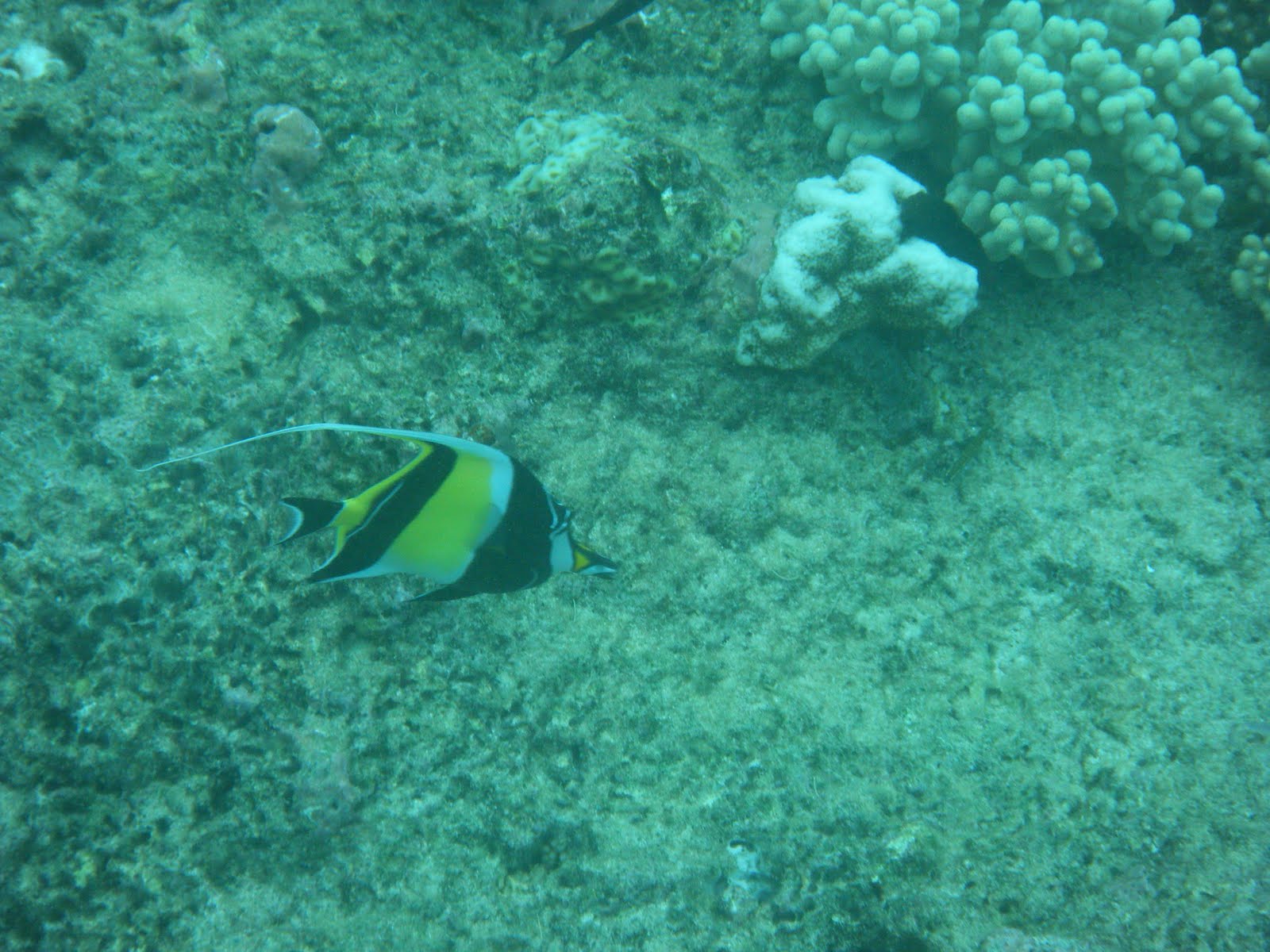
Also not a butterflyfish
No, this is a Moorish Idol (Zanclus cornutus) but you could be easily forgiven for this mistake. It very closely resembles the Schooling Bannerfish (Heniochus diphreutes), the main difference being that Bannerfish are not as yellow and do not have as large and prominant black stripe behind the head.
I followed this fast moving fellow hoping to get a nice side view, had to settle for just glimpses from above.
Monday, 26 April 2010
They come in pairs
Its not unusual to see pairs of fish swimming on the reef - in this case what I thought at first glance to be two damselfish turned out to be a pair of two-barred rabbitfish. Its interesting how they stayed together, despite being pursued by a giant potential predator (me). Not the first time that I saw paired fish moving together rather than splitting off in different directions.
Pairing behavior is better studied in some species of damselfish, where monogamous pairs of individuals will stay in close proximity on the reef, maintaining a territory and reacting antagonistically to any intruding fish from the same species. The pair of Blackback Butterflyfish (Chaetodon melannotus) I observed below seemed to be a pair, but later I saw a third Blackback come and join them without any conflict.
Sunday, 25 April 2010
Giant clams

One of the most fascinating creatures of the reef were the giant clams (Tridacna sp., Family Tridacnidae), which could be found both as large "free-standing" individuals or as smaller clams embedded in the coral. Amazingly, it used to be thought that divers could get themselves "trapped" by these clams, but when put to the test, I found that they closed slowly, and never completely.

Tridacna gigas, the classic Giant Clam, at Michaelmas cove, off of Cairns.

Tridacna gigas again, this time with the mantle retracted. Interestingly, these clams get about 70% of their energy from photosynthesis, due to symbiotic algae in the mantle.

This one is Tridacna crocea, a smaller species (this individual is about 10cm long) almost always found embedded in coral up to the margins. These were quite common in large coral heads, but easily overlooked if you weren't keeping an eye open.
Subscribe to:
Posts (Atom)